

What to Wear on a Cold-Weather Hike: Layering Without Overheating
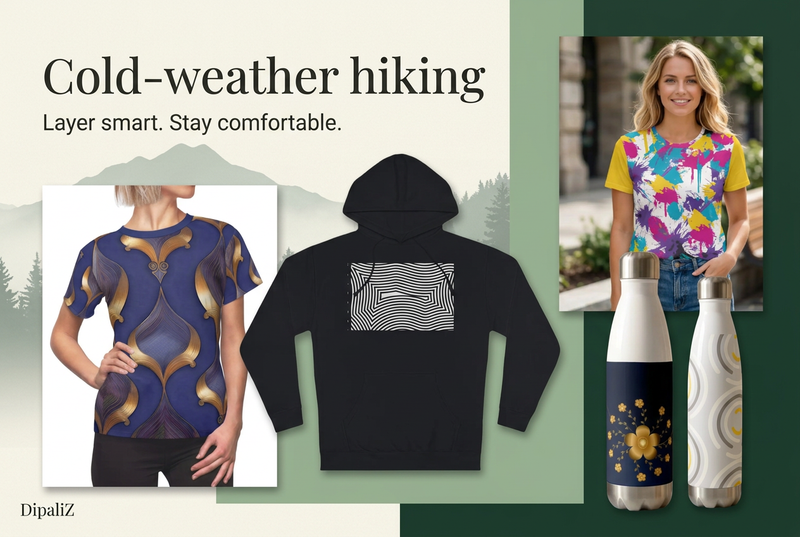
Cold weather hiking layers come down to three pieces: a synthetic base layer against your skin, an insulating midlayer you can take off, and a wind or rain shell on top. Start the trail slightly cold. You will be warm within ten minutes of walking uphill, and the hiker who dressed to feel cozy at the trailhead is the one soaked in sweat by the first mile.
DipaliZ is an independent, women-owned brand in Michigan. We print each piece after you order it, including everything in our water bottles collection, and plant a tree for every $20 spent.
Here is the mistake almost everyone makes on a cold day. You stand in the parking lot, feel the wind, and put on everything you brought. Twenty minutes later you are climbing, generating as much heat as a small radiator, and there is nowhere for it to go. Then you stop for a snack, the sweat cools, and you spend the rest of the afternoon genuinely cold.
Our Top Picks from DipaliZ


The Three-Layer System in Plain Terms
Every piece of cold weather hiking advice is some version of the same three jobs. Once you know which job a garment is doing, you stop guessing.
1. The base layer moves sweat away from your skin
This is the only layer that touches you, and its whole purpose is to stop sweat from sitting against your body. It should be close-fitting and synthetic or wool. The Navy Blue Abstract Pattern Tee at $36.35 is 100% polyester, which is the fiber that does this job, and the dark all-over print hides a day of trail dust better than a pale shirt does.
2. The midlayer holds warm air
Fleece, a sweatshirt, a light down piece. This is the layer that comes off at the bottom of the first hill and goes back on at the summit, so the thing that matters most is how easy it is to take off and stuff into a pack.
3. The shell blocks wind and rain
A thin shell is worth more on a cold day than almost any amount of extra insulation, because moving air strips heat far faster than still cold air does. Wind is what makes 40 degrees feel like 25.
Why You Overheat in the First Mile
Walking uphill with a pack raises your heat output roughly five to eight times over standing still. That is the whole problem in one sentence: you dressed for the person standing in the parking lot, and within ten minutes you are a different person.
The fix is a rule, not a garment. Start cold. At the trailhead you should feel slightly underdressed and want to get moving. If you are comfortable standing still, you are wearing one layer too many.
Three habits that follow from it:
- Take a layer off before you think you need to. The moment you notice you are warm, you are already sweating. Stop and strip, even if it feels early.
- Use the zippers and the hood first. Opening a collar or pushing a hood back dumps a surprising amount of heat and costs you nothing.
- Put the midlayer back on the instant you stop. Not five minutes later. The cool-down at a snack break is where cold afternoons begin.
Cotton, Synthetic or Wool Against Your Skin
This is where a cold hike is won or lost, and the difference is simple: cotton holds water and synthetics do not.
A cotton tee soaks up sweat, stays wet, and then pulls heat out of you every minute you wear it. On a warm summer walk that is pleasant. In November it is the reason people get genuinely cold on an easy trail. Polyester moves moisture outward instead of absorbing it, and wool keeps some warmth even damp.
Where cotton is still fine:
- A short, flat walk where you will not break a sweat at all.
- The drive and the parking lot — plenty of people hike in a synthetic shirt and keep a cotton tee in the car to change into afterward, which is a genuinely good system.
- Outside the base layer, as a midlayer, where it is not sitting against wet skin.
That last point is where a sweatshirt earns its place. The Abstract Hooded Sweatshirt at $38.32 has a cotton face over a polyester fleece back, which makes it a good layer to pull on at the summit, at the overlook and back at the trailhead afterward — not the shirt to sweat into on the climb. The Life’s too Short to Wait Tee at $29.37 is the opposite case: a polyester jersey, so it is one to wear underneath. More tops that work either way are in our tops collection.
What to Pack Rather Than Wear
A cold-weather day pack is mostly things you are not currently wearing. For a half-day hike in the 30s and 40s, that usually means five items.
- The midlayer. On your back for the climb, on your body at the top. This is the single most-used thing in the bag.
- A hat and thin gloves. Tiny, weightless, and the fastest way to change how warm you feel without changing layers.
- A dry spare top. If you do end up soaked, having something dry at the summit turns a miserable descent into a fine one.
- The shell, even on a clear forecast. Weather at elevation is not the weather in the parking lot.
- Water. More than you think, for the reason below.
Hydration in the Cold: Why You Drink Too Little
Thirst drops sharply in cold weather. You can lose as much fluid on a cold hike as a warm one — through sweat under all those layers and through every breath you can see — while feeling barely thirsty at all. Most people simply forget to drink.
Two practical answers. First, carry an insulated bottle rather than a thin plastic one: a double-walled bottle keeps water from going painfully cold, and in freezing temperatures it is much slower to ice up. The Navy and Gold Stainless Steel Bottle at $21.55 is double-walled with a leak-proof cap, which matters when it is lying on its side in a pack. The Abstract Circles Slim Bottle at $20.98 holds 20 oz in a vacuum-sealed steel body and fits a side pocket, so it is the one you will actually reach for mid-trail.
Second, drink on a schedule instead of on thirst. A few mouthfuls every twenty minutes, or one deliberate drink at every stop. A warm drink works too — an insulated bottle will hold tea for hours, and there is a real morale difference between cold water and something hot at a windy overlook. Our drinkware collection has more shapes and sizes if you want one bottle for the trail and another for the desk.
One more cold-weather detail: store the bottle upside down in your pack if temperatures are below freezing. Water freezes from the top, so an inverted bottle ices at the base and leaves the mouth clear.
What You Are Choosing at Checkout
Worth being straightforward about two things.
First, DipaliZ does not make technical mountaineering gear. What we make are the wearable layers around it — tees, sweatshirts, hoodies and insulated bottles — so for a hard shell or crampons, a dedicated outdoor retailer is the right call. Everything above is chosen for the jobs it genuinely does.
Second, every piece here is pre-designed: the artwork is ours, printed before it ships, and what you choose is the size and the color. There is no field at checkout to add a name, a date or a monogram to any of them. Everything is brand new and printed to order, so plan around two stages — production, then shipping — and use the estimate shown on the product page rather than any day count we could print here. Fiber content and sizing are on each listing too, which is worth checking on anything you intend to wear as a base layer.
Find the Perfect Gift at DipaliZ
Browse our full range of gifts — made for every passion, every person, every occasion.
Shop All Gifts →Three layers, one rule, and a bottle you remember to drink from. Start cold, shed early, put the midlayer back on the moment you stop, and the cold stops being the thing you think about on the trail.

Keep reading
All posts
Botanical Wall Art Made in the USA -- Original Prints from a Small Michigan Shop
Bring nature indoors with DipaliZ botanical wall art and floral pillows. Explore newer framed prints, coordinating September additions, and an earl...

DTG, Sublimation or Embroidery? How Your Shirt Was Actually Printed
DTG, sublimation or embroidery: how each method puts a design on a shirt, which fabrics each one needs, and how to tell what made the tee in your c...

Cozy Work-From-Home Outfits for the Cold Months
Five work-from-home outfits for cold months, built on a camera-up formula that looks composed on video calls and feels like nothing by 4pm.

